
Drum & Rhythm Classes
Rhythm doesn't belong to anyone, and everybody can do it.
Forty years of drumming has taught me that underneath every tradition I've trained in — Indian, African, or Afro-Cuban — there's a layer the lineages don't quite name. A grammar. The human capacities for rhythm, listening, and entrainment that show up wherever people drum together. The grammar itself is already yours.
Rhythm is in our nature. That's how we're built. That's what I teach. Across every class — kids, beginners, individual students, a circle finding a beat together — the approach is the same.
It goes with the person, not the curriculum
Whether it's a child working with attention, an adult sitting down at a drum for the first time, or a circle of beginners, I work with who's actually in the room — not who I expected and not who the lesson plan was written for.
Experience comes first, explanation second
You'll play before I tell you what you're doing. The body learns rhythm through doing, not through being lectured at. Once something has happened in your hands, naming it lands as recognition rather than instruction.
Small reliable results, building lasting skills
Most music teaching promises virtuosity at the end of a long road. I'm interested in what works in the next ten minutes. A hand that lands cleanly. A pulse you can keep without thinking. A rhythm shared with one other person.
Independence is the goal
A teacher's job is to become unnecessary. I want you playing on your own — at home, in a circle, with your kids, in a quiet moment by yourself — long after our work together ends.
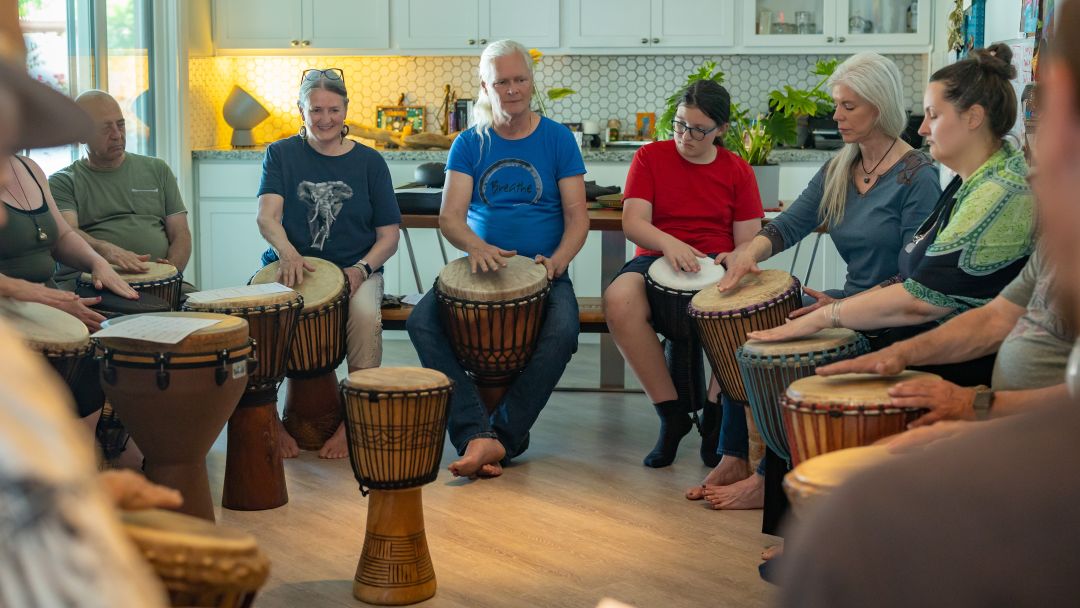
Rhythmic Awakening - Drum and Rhythm Basics
A three-hour beginner workshop — what I used to call Rhythmic Awakening. No prior experience needed and drums are provided. We start from the rhythm already in your body and build from there: how to make a clean sound, how to hold a pulse, how to listen and play at the same time. By the end of the afternoon, you've made music with strangers and walked away knowing rhythm is something you can actually do.
Individual Drum Lessons
One-on-one work, in person in San Francisco or remote. Some students come with a specific drum they want to learn — djembe, conga, frame drum, dunun. Others come because they want time to slow down and listen. We work with whatever's actually in your hands and what you're hearing in the music you love. Single sessions or four-session packages, sliding scale available.
Children & Parent - Child Drum Classes
Basic rhythmic education for skill and emotional regulation. Many of these kids have a hard time focusing — especially on the kind of attention it takes to learn a pattern. Drumming offers something most of their day doesn't: physical-cognitive learning, closer to sports or exercise than to schoolwork. The repetitive nature of it makes mistakes part of the process — you try the pattern, miss it, try again, until it sticks. Once a child accepts that there's no learning without mistakes, something opens. And every step of learning a pattern is also a tuning step for the nervous system. Children won't always notice this. The body does. Better regulation, more settled body-mind, the benefits research has been documenting for years — these arrive quietly underneath the work of learning the rhythm itself. Classes can be child-only, or parent-child together so the rhythm comes home with you.
I currently have a group of 3 8 year old that go together to school. That's wonderful, it works. Got ideas? Let's talk 🙂